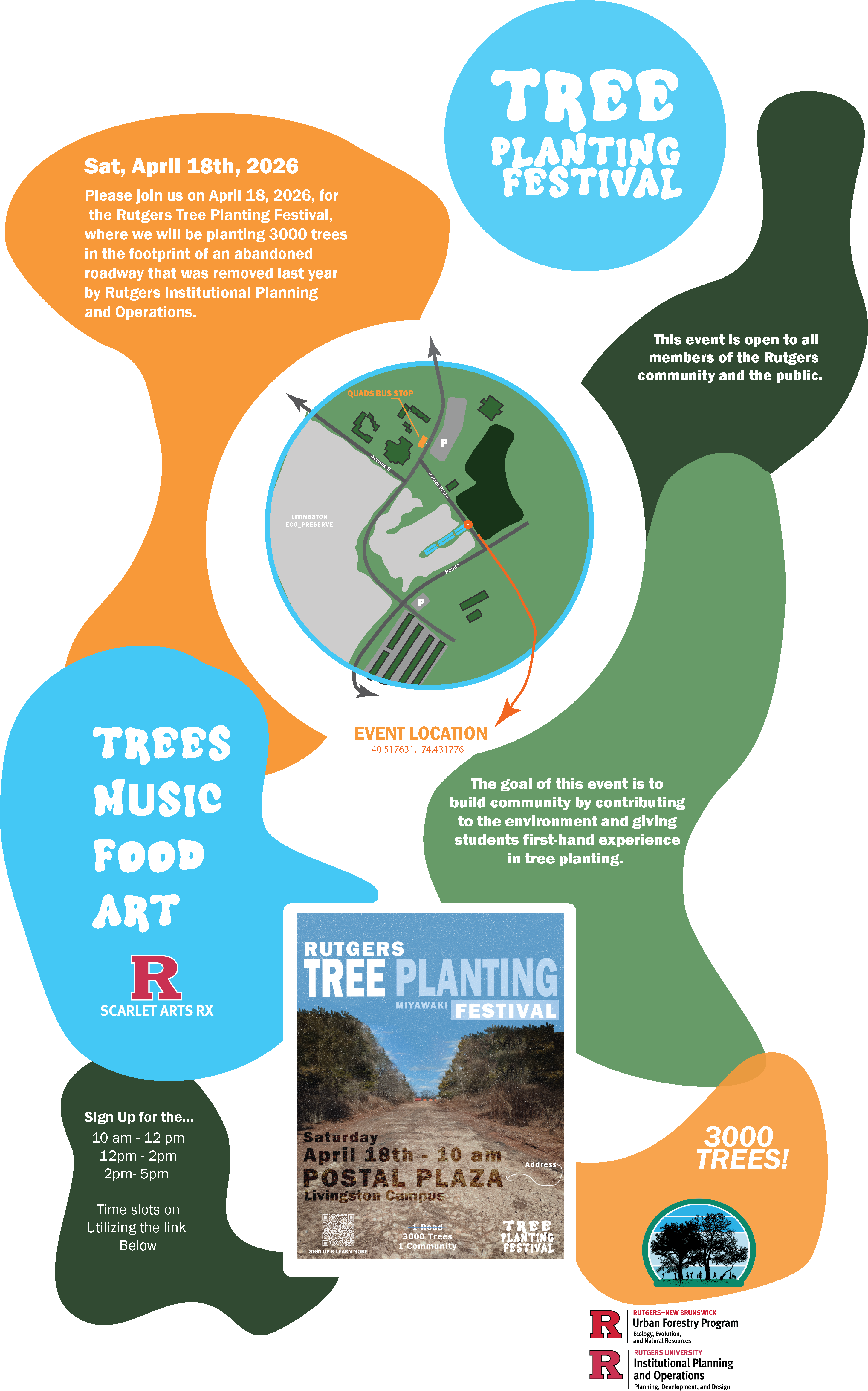
Rutgers Tree Planting Festival

Rutgers Miyawaki Forest
We are excited to announce the installation of the first Miyawaki Forest on the Rutgers University Campus. This project blends ecology research, community participation, and design.
Rutgers University Planning, Development, and Design (PDD) within the Institutional Planning and Operations (IPO) division is installing a Miyawaki forest using an NJDEP Stormwater Grant awarded to Rutgers University in 2023.
The location for the planting on April 18th can be found here: https://maps.app.goo.gl/DgJ8n7bi1Th33R1U6
Questions about the Tree Planting Festival? Please email Josh Kover, jbk118@rutgers.edu
REGISTRATION IS NOW CLOSED FOR TREE PLANTING
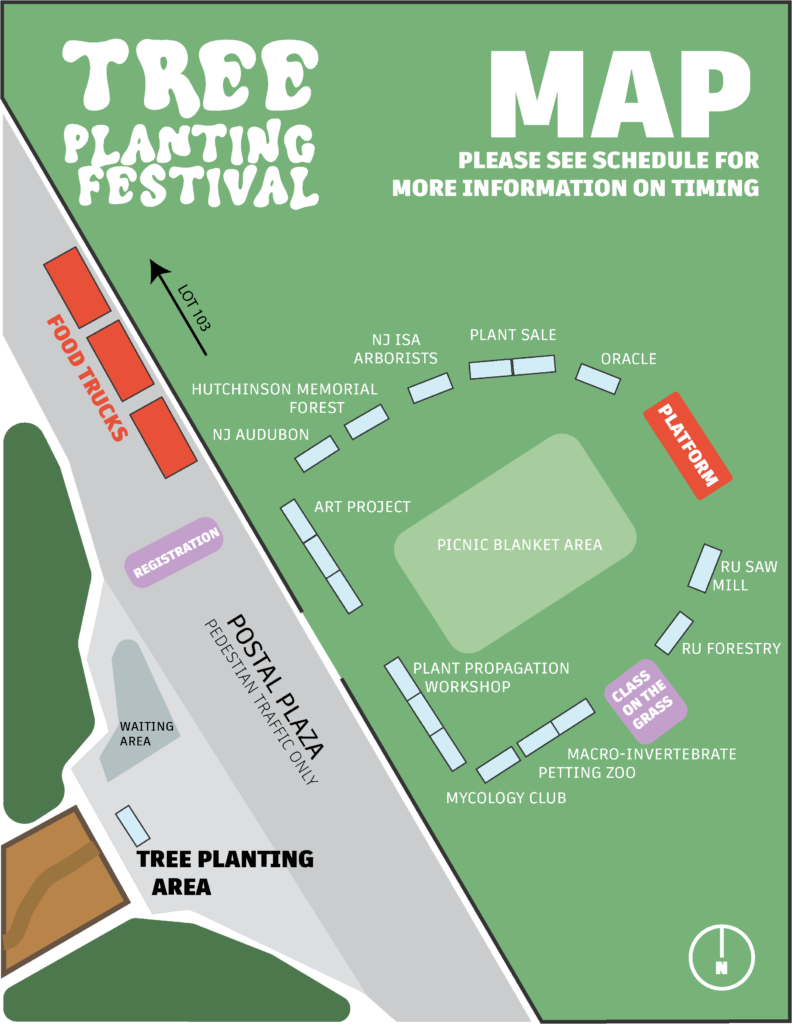
However, all are welcome to participate in the live music, food trucks,
art project by Scarlet Art RX, and other educational tree activities (the Festival portion).

-
Developed in the 1960s and 1970s, the Miyawaki Method was a response to a conservation need in Japan by Dr. Akira Miyawaki. His idea was that Japan needed native forests for disaster prevention, but he recognized that creating one through natural succession would take far too long (150+ years). The Miyawaki method seeks to accelerate natural succession by 10x, leveraging a synergy of theories including late-succession species, soil remediation, and increased planting density. The Miyawaki method has evolved to take on many names, including “tiny forests,” “Micro forests,” healing forests,” etc.
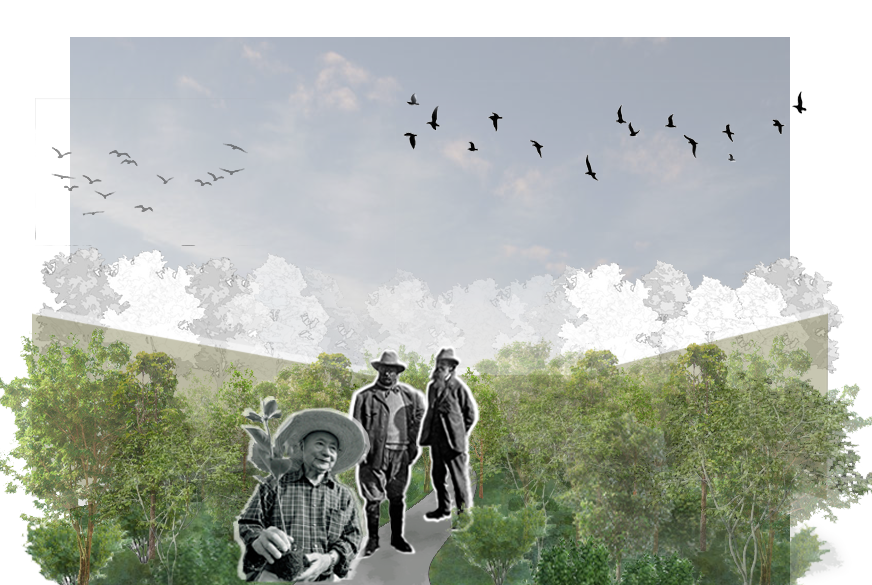 Graphic: Akira Miyawaki at the LARER site (By Josh Kover)
 -
- Identify the site’s native late-successional plant community.
- Amend the soil with organic matter.
- Plant densely (3-7 plants / sq m)
- Plant all layers of the Forest.
- Canopy
- Understory
- Shrub
- Herbaceous
- Plant Saplings (Small Trees)
- Plan the Festival: Involve the Community
-
Rutgers University Planning, Development, and Design (PDD) within IPO is installing a Miyawaki Forest using an NJDEP Stormwater Grant awarded to the University in 2023.
Rutgers University’s Miyawaki forest, known as the Livingston Abandoned Roadway Environmental Restoration (LARER), is a project on the Rutgers Livingston campus that was intended to increase stormwater infiltration and biodiversity. The process first included the removal of an abandoned roadway that dated back to the Camp Kilmer WWII training camp, which had prevented natural succession from taking place for decades. Second, we modified the soil to remediate the compaction from the roadway through a process known as “scoop and dump”. Finally, we designed and will install a climate-resilient, biodiverse, and native plant community that will support the environment and local ecology for decades to come.

Graphic of the history of the land at the LARER site (By Josh Kover)
-
The LARER will be used by students, faculty, and extension specialists for teaching, learning, and research throughout its lifetime. There are many unanswered questions about the “Miyawaki Method,” and as a result, there is a lot of confusion about the method within the industry. This site will be used to start answering those questions as a statewide resource. This research on the site will be done holistically, focusing on its social and environmental elements. Already, this site is being used as research focusing on how the soil microbiome might change during the transition from grey to green infrastructure. In addition, it will be used to understand the maintenance requirements at different planting densities, the long-term effects of planting so densely, and will be used as a case study for designing forest communities. These studies are novel and interdisciplinary, drawing on forestry, landscape architecture, and human ecology.